Shipment integrations
- How to send shipment data to Cloudex TMS via API?
- How to send shipment milestones to Cloudex TMS via API?
- How to send shipment documents to Cloudex TMS via API?
How to send shipment data to Cloudex TMS via API?
Use the Cloudex TMS API when shipments created in another system need to be automatically imported into Cloudex TMS.
This is typically the first step of a shipment integration between an external TMS, ERP, customer system, or another application and Cloudex TMS.
Before you start
You need:
- access to the Cloudex TMS API;
- a valid Cloudex API key;
- access to the Cloudex TMS API documentation.
See: How to create API key
Full Cloudex TMS API documentation: https://my.cloudex.lv/cloudex-api/swagger/index.html
Which endpoint should be used?
To create/import a shipment in Cloudex TMS, use the: shipment-manifest endpoint.
The external system sends the shipment information to Cloudex TMS using this endpoint.
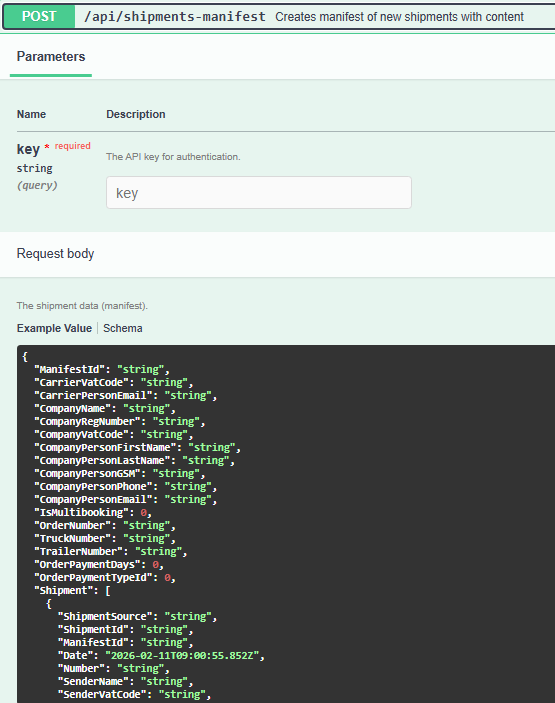
Integration flow
A typical shipment integration works as follows: External system → Shipment manifest → Cloudex TMS
Related articles
How to send shipment milestones to Cloudex TMS via API?
Use the Cloudex TMS API milestones endpoint when an external system needs to update Cloudex TMS about the progress of an existing shipment.
Examples include shipment milestone/status updates such as:
- Shipment loaded;
- Shipment delivered.
Before you start
The shipment must already exist in Cloudex TMS and the external system must be able to identify which Cloudex TMS shipment the milestone belongs to.
You also need:
- access to the Cloudex TMS API;
- a valid Cloudex API key.
Full Cloudex TMS API documentation: https://my.cloudex.lv/cloudex-api/swagger/index.html
Which endpoint should be used?
To send shipment milestone/status updates to Cloudex TMS, use the: milestones endpoint.
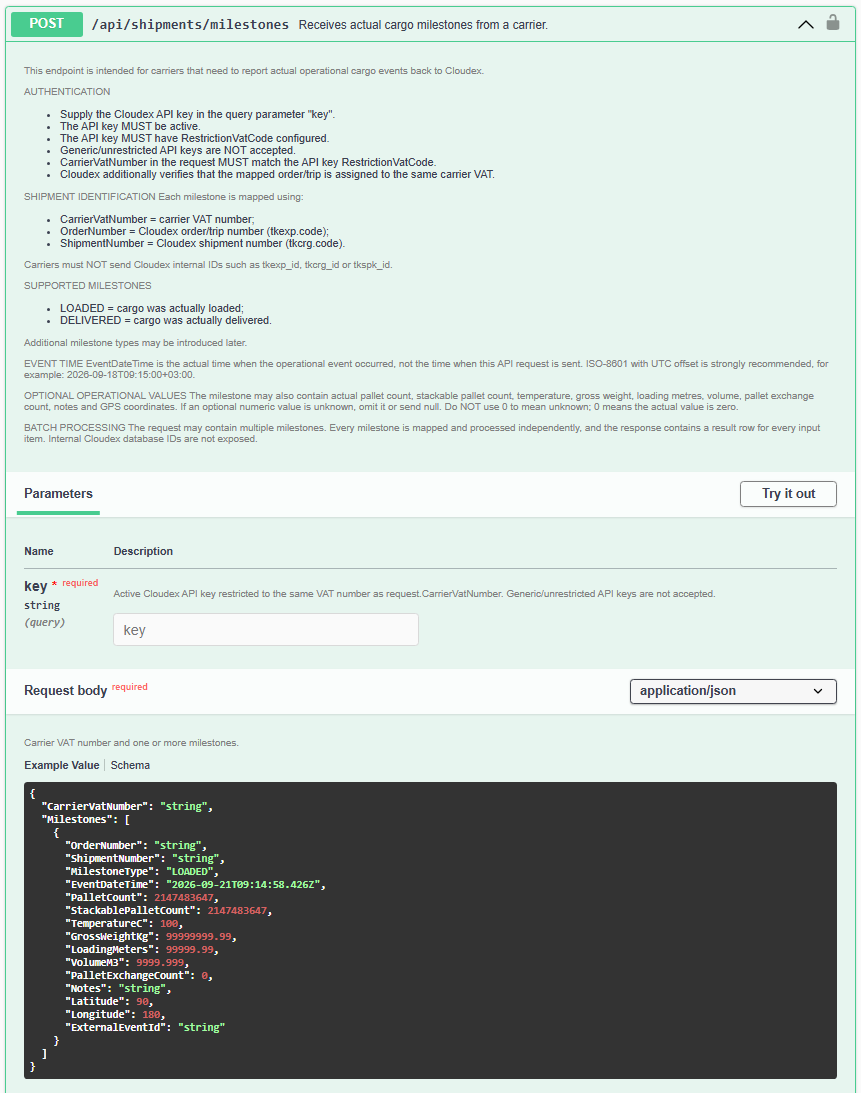
Integration flow
A typical integration works as follows: External system → Shipment milestone/status → Cloudex TMS
For example, when the shipment is marked as delivered in the connected external system, the corresponding milestone can be sent to Cloudex TMS.
This allows Cloudex TMS to keep the shipment status synchronized with the connected system without requiring users to update the shipment manually.
Related articles
How to send shipment documents to Cloudex TMS via API?
Use the Cloudex TMS API documents endpoint when documents from an external system need to be attached to a shipment in Cloudex TMS.
Typical examples are:
- POD (Proof of Delivery);
- CMR;
- other shipment-related documents.
Before you start
The shipment must already exist in Cloudex TMS and the external system must be able to identify which shipment the document belongs to.
You also need:
- access to the Cloudex TMS API;
- a valid Cloudex API key.
Full Cloudex TMS API documentation: https://my.cloudex.lv/cloudex-api/swagger/index.html
Which endpoint should be used?
To send shipment documents to Cloudex TMS, use the: documents endpoint.
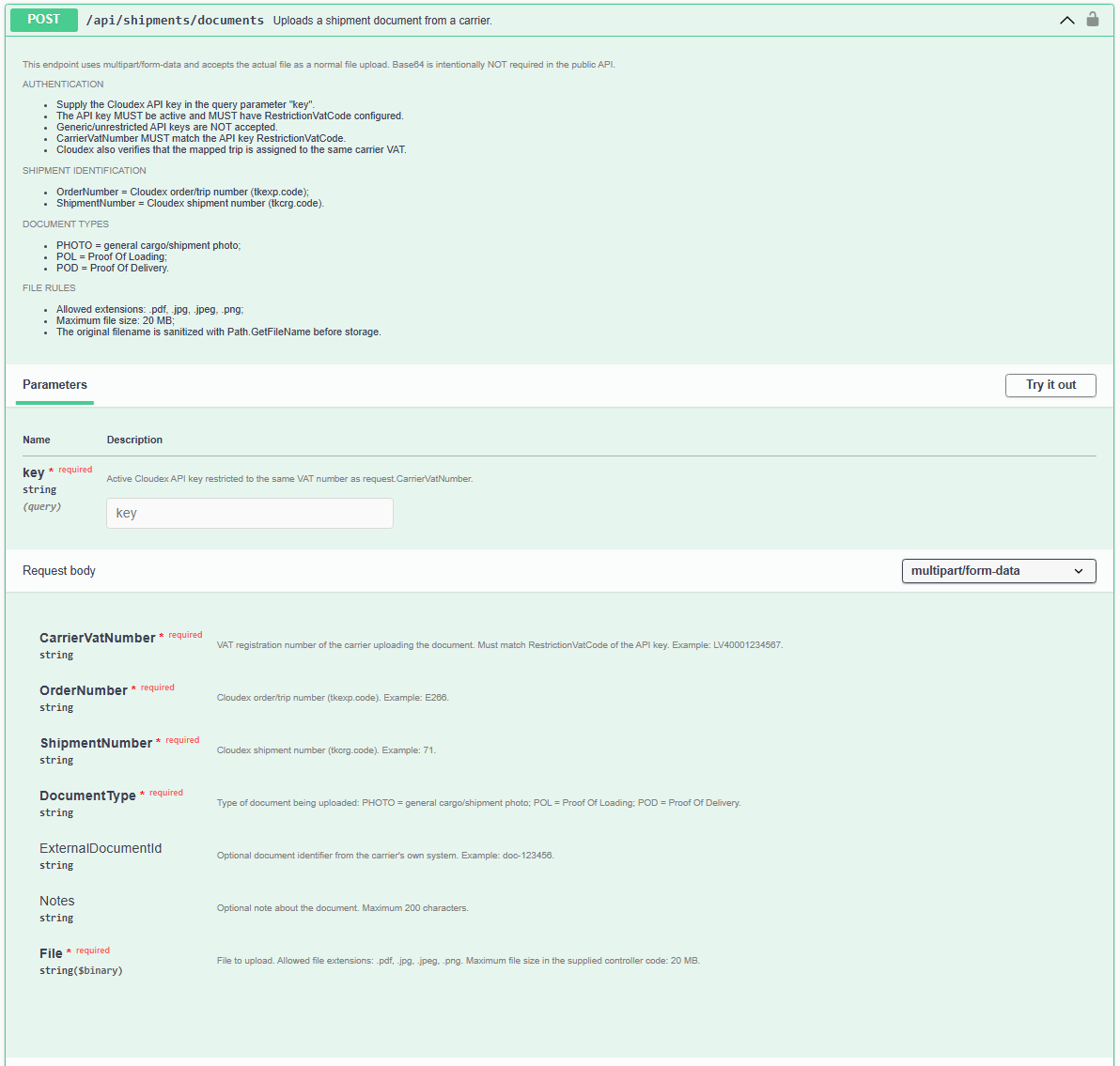
Integration flow
A typical document integration works as follows: External system → Shipment document → Cloudex TMS shipment
For example, once a signed POD or CMR becomes available in the connected system, it can be sent automatically to Cloudex TMS and linked to the corresponding shipment.
This reduces the need to manually download documents from one system and upload them again into Cloudex TMS.